Healthcare organizations are under increasing pressure to protect revenue integrity while maintaining operational efficiency. Therapy departments, in particular, are feeling the strain. Between staffing shortages, rising denial activity, evolving payer scrutiny, and growing documentation demands, leaders are being asked to do more with less—without sacrificing compliance.
At the same time, therapy services remain an area of significant audit risk. Even small inconsistencies between documentation, coding, and billing can create financial exposure, trigger payer reviews, or delay reimbursement. For many organizations, the challenge is no longer simply whether documentation exists, but whether the entire encounter tells a complete, defensible story from start to finish.
That is where encounter integrity becomes critical.
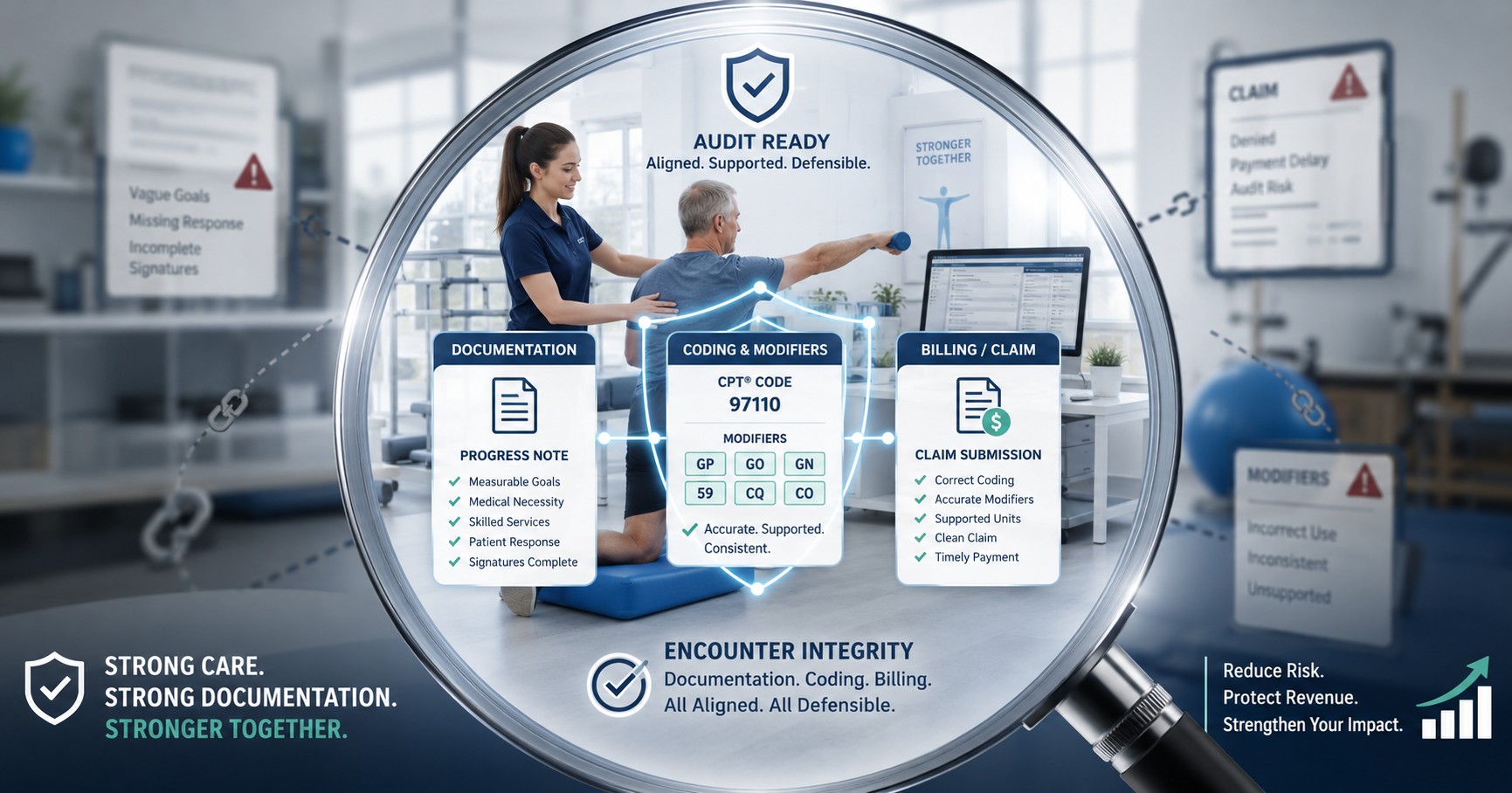
In therapy services, compliance is not achieved through documentation alone. True encounter integrity occurs when documentation, coding, and billing all align to accurately support the care provided.
For PT and OT services, the medical record must clearly demonstrate:
- That skilled therapy was medically necessary
- That billed services were actually performed
- That time and units were calculated correctly
- That CPT coding reflects documented treatment
- That required elements such as plans of care, progress notes, and signatures are complete
If any one of these components is missing or inconsistent, the entire encounter becomes vulnerable.
Even strong therapy departments can develop gaps that create compliance and reimbursement risk, including:
- Units billed that do not match documented time
- Treatment descriptions that fail to support CPT code selection
- Progress notes that do not justify continued care
- Assistant modifiers unsupported by documentation
- Expired or incomplete plans of care
Individually, these issues may appear minor. Collectively, however, they can contribute to denials, repayment risk, and operational inefficiencies.
Unlike many specialties, therapy services involve highly specific documentation and billing requirements. As a result, generalized compliance reviews often fail to identify the nuanced risks unique to PT and OT programs.
Focused therapy audits provide organizations with a more meaningful evaluation of:
- Time calculation accuracy
- Modifier usage
- Medical necessity support
- Goal setting and progress tracking
- Certification and plan of care compliance
Regular monitoring—both internally and through independent external review—helps organizations identify issues proactively before they surface in payer audits or denial trends. It also provides valuable education opportunities for clinicians, coders, and operational leaders alike.
BCA, Inc. supports organizations through targeted audit, education, and consulting services designed specifically for specialized compliance risk areas. From comprehensive reviews to focused assessments such as RapidCheck audits, our team helps organizations evaluate documentation-to-claim alignment, coding accuracy, modifier usage, unit calculations, and overall encounter integrity.
For organizations looking to strengthen compliance oversight while improving revenue performance, a focused therapy review can provide the clarity and direction needed to move from reactive corrections to proactive improvement.
Connect with an expert today.