Healthcare leaders are navigating an increasingly difficult compliance environment. Between staffing shortages, evolving payer expectations, telehealth scrutiny, and pressure to maintain productivity, many organizations are asking the same question: Would our documentation and billing practices hold up under external review?
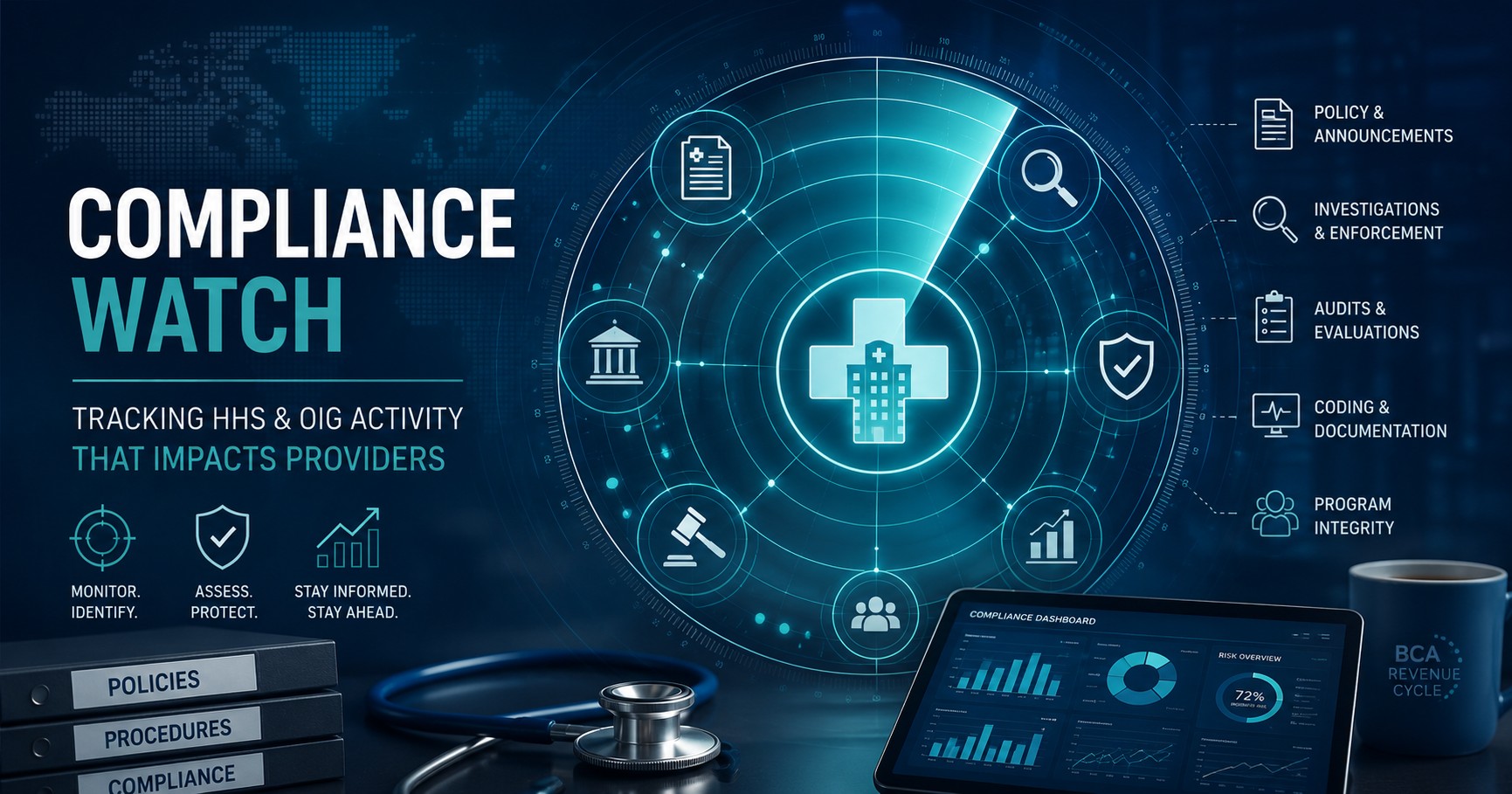
That concern is becoming more relevant as the Office of Inspector General (OIG) and Department of Justice continue expanding enforcement activity around healthcare billing, coding, and documentation practices. One recent area receiving significant attention is telehealth and virtual care billing, where regulators are identifying patterns tied to unsupported services, improper modifier usage, and insufficient documentation.
In a recent OIG audit, CMS identified more than $2.2 million in potentially improper payments related to virtual check-ins and e-visit services billed between 2019 and 2022. According to the report, many claims involved services billed too close to separately payable E/M visits or included modifiers that may not have been appropriate under Medicare requirements. The findings highlighted how both workflow gaps and billing practices can contribute to compliance risk.
What makes this particularly important is the broader shift happening across healthcare enforcement. Regulators are no longer focused only on large-scale fraud schemes. Increasingly, agencies are using advanced analytics and data modeling to identify billing anomalies, documentation inconsistencies, and utilization trends that suggest elevated compliance risk. In many cases, enforcement activity begins with statistical patterns that appear outside expected norms.
For providers and healthcare organizations, this reinforces the importance of treating documentation integrity and coding accuracy as operational priorities rather than reactive audit projects. Repeated use of high-level E/M services, unsupported telehealth claims, excessive modifier usage, or inconsistent documentation can quickly attract payer or regulatory attention when patterns emerge across claims data.
Organizations should evaluate whether current compliance processes are proactive enough to identify vulnerabilities before regulators do. Internal auditing efforts should routinely focus on high-risk areas such as telehealth, modifier usage, prolonged services, medical necessity documentation, and risk-adjustment coding. Just as importantly, provider education should emphasize the clinical reasoning and documentation support behind coding decisions—not simply reimbursement outcomes.
A strong compliance culture also depends on creating an environment where documentation and coding concerns can be escalated early and addressed consistently. Many healthcare organizations are feeling increasing pressure between productivity demands and compliance expectations, making ongoing education and objective auditing more important than ever.
For organizations looking to strengthen compliance readiness, proactive support can make a meaningful difference. BCA, Inc. provides audit, education, and consulting services designed to help healthcare organizations identify documentation and coding vulnerabilities, improve provider confidence, and build defensible compliance processes before issues become enforcement actions.
Book your consultation today with one of our experts.