For many healthcare organizations, accurate documentation and coding have become increasingly important as teams balance regulatory requirements, reimbursement pressures, and the need to be prepared for audits and reviews. CMS continues to emphasize accurate coding, billing, and medical record documentation as part of its Medicare compliance activities.
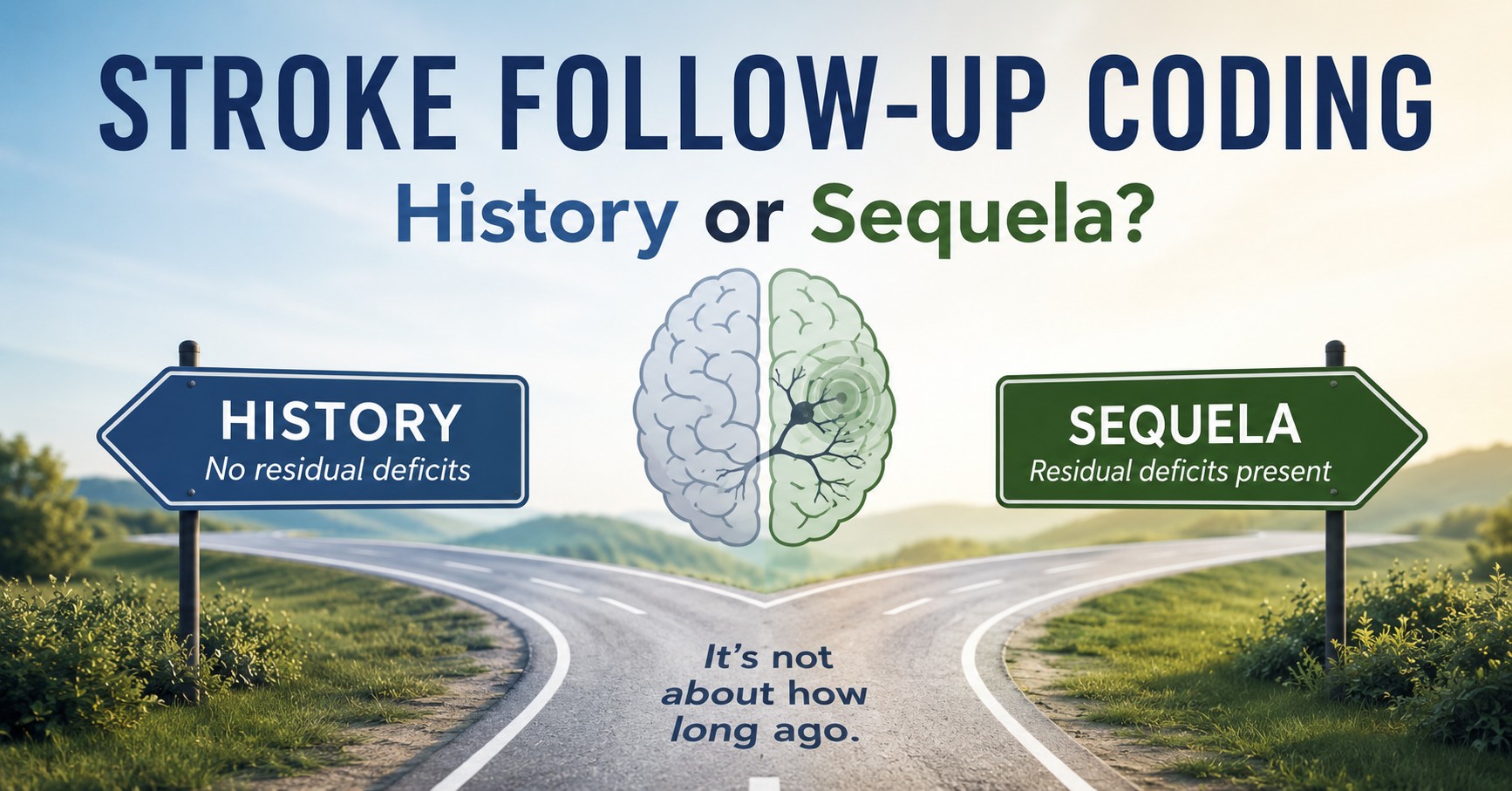
One area that can create confusion is the coding of patients seen after a stroke. When a patient presents days, months, or even years after a cerebrovascular event, should the stroke be reported as a personal history, or is the patient experiencing a residual effect (sequela) of the stroke?
The answer depends less on how long ago the stroke occurred and more on the patient’s current clinical status.
A personal history code may be appropriate when the prior condition is no longer present, and the patient does not have residual neurologic deficits.
For example, Z86.73, Personal history of transient ischemic attack (TIA), and cerebral infarction without residual deficits, is used when a patient has a history of TIA or cerebral infarction without residual deficits. Even if it has only been days since the onset of the disease.
The FY 2026 ICD-10-CM Official Guidelines specifically state that codes from category I69 should not be assigned when the patient does not have neurologic deficits.
When a patient continues to experience a condition resulting from a previous cerebrovascular event, a code from category I69, Sequelae of cerebrovascular disease, may be appropriate.
Examples include residual:
- Hemiplegia or hemiparesis
- Cognitive deficits
- Speech and language deficits
- Dysphagia
- Facial weakness
- Ataxia
The documentation should identify the specific residual condition and support its relationship to the prior cerebrovascular disease.
Is there a time limit for using a sequela code?
No. ICD-10-CM does not establish a specific number of days, months, or years after a stroke when I69 codes must stop being used.
The Official Guidelines explain that neurologic deficits caused by cerebrovascular disease may be present from the onset or may arise at any time after the onset of the cerebrovascular disease.
That means the passage of time alone does not automatically make a stroke a ‘history of’ condition. The patient’s current clinical status is what matters.
When reviewing a patient’s history of stroke, consider:
Does the patient have a current residual condition related to the prior stroke?
- Yes: Consider the appropriate I69 sequela code based on the documented deficit and type of cerebrovascular disease.
- No: A personal history code, such as Z86.73 when applicable, may be appropriate.
For organizations looking to strengthen coding accuracy, these distinctions are a good example of why documentation, coding, and clinical understanding need to work together. When documentation clearly describes the patient’s current condition and its relationship to a prior stroke, coders are better positioned to select the code that accurately reflects the patient’s status today.
If your organization is seeing inconsistent stroke coding, documentation gaps, or questions about whether coding practices accurately reflect the medical record, BCA, Inc. can help. Our audit, education, and consulting services can help identify opportunities, educate your team, and turn audit findings into practical improvements in documentation and coding accuracy.
Connect with an expert today.