
In 2026, safety-net providers and community-based organizations are facing a familiar but intensifying set of challenges. Funding uncertainty, shrinking margins, workforce shortages, and growing behavioral health demand are forcing clinics to examine every aspect of how care is delivered, documented, and reimbursed. For many organizations, behavioral health services sit at the center of this pressure—expanding rapidly to meet patient need, yet often operating across multiple care models with very different documentation and coding expectations.
One area where confusion commonly arises is the distinction between Integrated Behavioral Health (IBH) and Specialty Behavioral Health. While both models play a critical role in patient care, misunderstanding how they differ can create downstream issues for documentation, coding accuracy, and compliance—risks that few organizations can afford in the current environment.
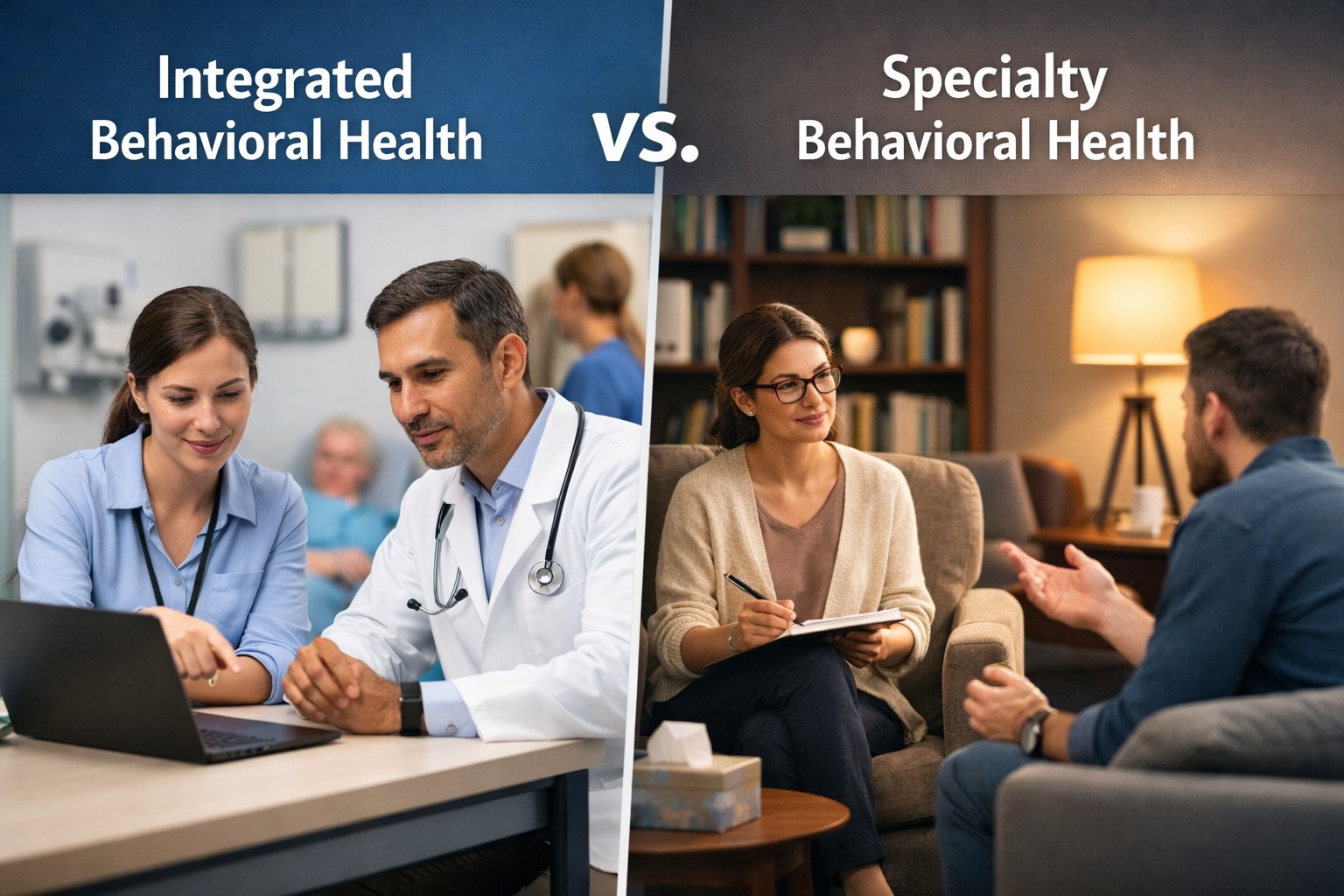
Integrated Behavioral Health embeds behavioral health services directly within primary care or other medical settings. The focus is typically on early identification, brief assessments, short-term interventions, and close collaboration with medical providers. IBH clinicians often address behavioral health concerns as part of whole-person care, working alongside physicians, nurses, and care teams to support patients in real time.
Specialty Behavioral Health, by contrast, generally involves more intensive or longer-term treatment provided by mental health specialists. These services often include comprehensive psychotherapy, psychiatric diagnostic evaluations, medication management, and ongoing treatment for complex or chronic behavioral health conditions.
These care model differences have practical implications for coding and billing. Integrated Behavioral Health services may involve brief interventions, health behavior assessments, or collaborative care models—each with specific documentation and coding requirements. Specialty behavioral health services more commonly rely on traditional psychotherapy and psychiatric evaluation codes, with different expectations around time, intensity, and clinical detail.
Documentation standards also vary. Integrated models emphasize coordination of care, linkage to medical conditions, and medical necessity within a broader treatment plan. Specialty behavioral health documentation typically requires more detailed psychiatric histories, symptom tracking, and longitudinal treatment progression. When documentation does not align with the actual care model being used, organizations may face denials, audit findings, or compliance concerns.
For coders, auditors, and compliance teams, understanding the underlying care model is essential to contextualizing documentation and selecting appropriate codes. Misalignment between service delivery and coding is rarely intentional—but it can have real financial and regulatory consequences, especially in an environment where audits and payer scrutiny continue to increase.
Clear, consistent education across clinical and administrative teams helps ensure that services are documented and coded in a way that accurately reflects how care is delivered. When Integrated Behavioral Health and Specialty Behavioral Health services are clearly distinguished, organizations are better positioned to support patient outcomes, protect revenue, and maintain compliance.
This is where many clinics decide to take the next step. BCA partners with safety-net providers through targeted audits, practical education, and focused consulting to help organizations align behavioral health documentation, coding, and operations with real-world care delivery. The goal isn’t to change how providers care for patients—it’s to ensure that the work already being done is clearly supported, accurately reported, and positioned for long-term sustainability in an increasingly challenging landscape.
Schedule a consultation with one of our experts.